
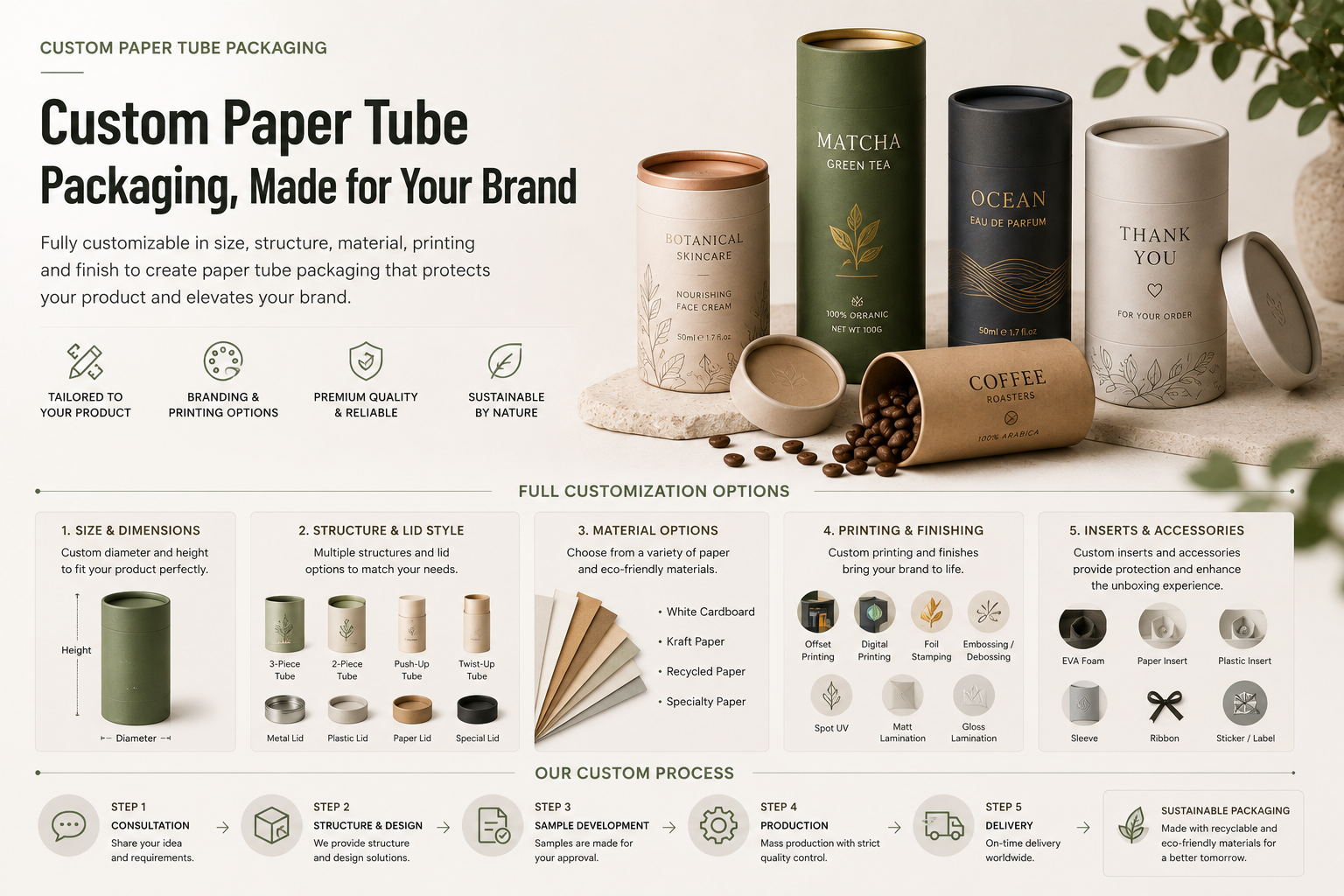
A distinctive silhouette
More than a container — a brand experience.
When buyers picture “packaging,” they usually think of boxes. But in categories like cosmetics, tea, spirits, candles, and gourmet food, the paper tube has quietly become one of the most powerful — and most underused — shapes on the shelf.
A well-designed custom paper tube doesn’t just hold a product; it tells a story, protects what’s inside, and gives a brand a distinctive silhouette that boxes simply can’t match.
Why brands are switching
Shape catches attention. Structure and storytelling keep it.
Sustainability customers notice
Paper tubes are typically made from recyclable, biodegradable kraft paperboard, often sourced from FSC-certified mills. For brands trying to reduce plastic and win over environmentally conscious consumers, switching from plastic jars or blister packs to a paper tube is one of the most visible sustainability upgrades a company can make.
Structural protection
The spiral-wound or convolute-wound construction used in paper tubes creates a rigid, crush-resistant cylinder that performs well in shipping — an important factor for cross-border e-commerce and DTC brands shipping direct to consumers worldwide.
360° design freedom
Unlike printed cartons, paper tubes offer a full 360-degree canvas. Labels can wrap seamlessly around the surface, and the end caps can be finished in a completely different color, material, or texture from the body — giving designers more creative range than a flat box front panel allows.
Industries getting the most value
The same base structure, completely different outcomes.
Premium unboxing that supports perceived value.
Brands use tubes for cream jars, serum bottles, and gift sets, where the presentation becomes part of the product experience.
Food, tea & coffeeGift-ready canisters with shelf presence.
Loose-leaf tea, coffee, and gourmet snack packaging can support both retail presentation and holiday-gifting channels.
Spirits & confectioneryRigid gift packaging with a custom-fit insert.
Single-bottle and premium confectionery formats use the tube to create protection and a more considered reveal.
Our custom process
Five stages from idea to delivery.
Consultation
Share the product, idea, market and requirements.
Structure & design
Review dimensions, wall strength, closure, liner, insert and artwork.
Sample development
Create a physical sample for fit, color, finish and handling approval.
Production
Move into mass production with defined quality controls.
Delivery
Prepare export packing and on-time shipment worldwide.
What to look for in a partner
Clarity before unit price.
- Can they provide a physical sample before committing to a bulk order, and how fast is sample turnaround?
- What is their minimum order quantity (MOQ) — and is it flexible for a first trial run?
- Do they support small-batch customization for testing new SKUs, or only large production runs?
- Can they share certifications such as FSC, ISO, BSCI, and others relevant to the target market?
- Do they offer structural engineering support based on the product’s weight and fragility, not just its appearance?
A supplier who can answer these clearly, and who is willing to iterate on a sample with you, is generally a stronger long-term partner than one offering only the lowest unit price.
Final thought
Sustainability, shelf differentiation and premium presentation — in one format.
Whether you’re launching a new cosmetics line, upgrading a tea brand’s retail packaging, or looking for a gift-ready format for a specialty food product, a tube built around your exact specifications — size, finish, cap, and print — can do more for your brand than a standard box ever could.
If you’re exploring custom paper tube packaging for an upcoming product launch, request a sample. Seeing and holding a real tube, printed with your actual branding, is the fastest way to know whether the format is right for your product.