
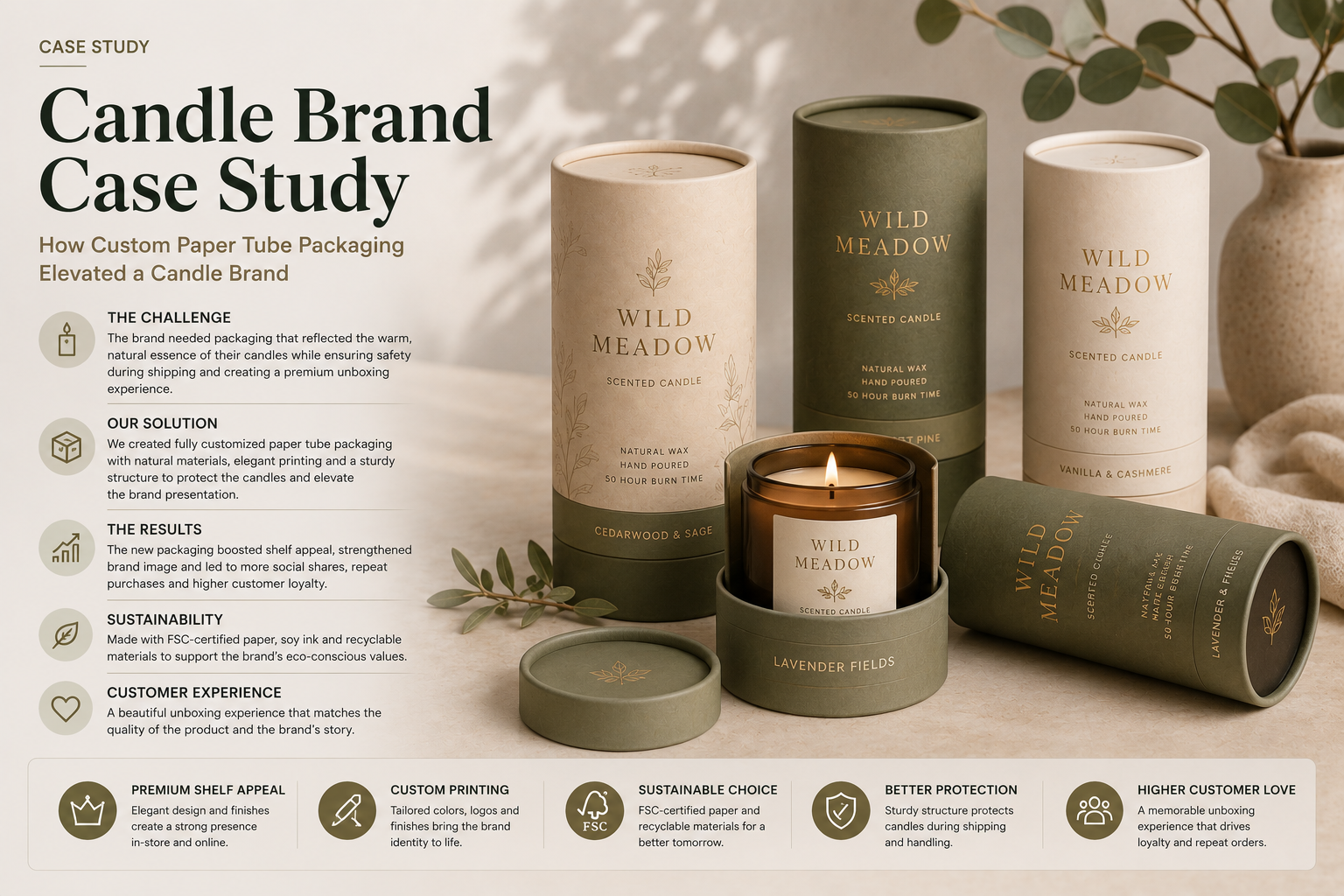
Protection meets presentation
One format solved two very different problems.
Candles present a packaging challenge that most other product categories don’t face: the product itself is heavy, breakable, and heat-sensitive, yet the brand still needs the packaging to look premium enough to justify a gift-price point.
This case study looks at how a boutique candle brand replaced its rigid cardboard box with a custom paper tube — and in doing so, solved a shipping-damage problem while upgrading its shelf and gifting appeal at the same time.
01 · The challenge
Fragile in transit. Generic at gifting.
The brand produced a line of hand-poured soy candles in glass jars, sold both through boutique retail and direct-to-consumer online orders. Their original packaging was a standard folding carton box, similar to what most mid-market candle brands use. Two problems kept surfacing:
Shipping damage
The flat-pack carton didn’t hold the glass jar securely enough during transit. Corners crushed easily, and several customers received candles with cracked jars or scuffed printed surfaces after standard parcel shipping — a costly problem given the fragility and weight of glass candle jars.
A look below the price point
The brand positioned its candles as a premium, gift-ready product, often purchased for holidays and special occasions. But the flat cardboard box read as generic mass-market packaging once it arrived — it didn’t carry the same “special occasion” feeling that the candle itself was meant to deliver.
The brand needed a packaging format that could hold a heavy glass jar securely, present well as a gift item straight out of the shipping box, and still work within a cost structure appropriate for a small-batch candle producer.
02 · The solution
A rigid kraft tube with a telescoping lid.
The brand moved to a two-piece telescoping paper tube — a rigid outer body with a separate lid that slides down over the top, fully enclosing the jar rather than just covering an open box top. A few specific decisions shaped how well this worked for candles specifically:
Thicker board for weight support
Thicker board walls for weight support. Because glass candle jars are considerably heavier than typical tube contents like cosmetics or tea, the manufacturer recommended a heavier-gauge spiral-wound paperboard wall than a standard tube — giving the structure enough rigidity to protect the jar without adding a plastic outer shell.
Full-body telescoping coverage
A snug telescoping lid instead of a friction-fit cap. Rather than a small push-on cap sitting on top of an open tube, the full telescoping lid slides down to overlap most of the tube body, sealing the jar in on all sides during transit and giving a satisfying “reveal” moment when the lid is lifted off — an important detail for a gift product.
A die-cut foam collar
A die-cut foam collar at the base. A custom-cut foam ring sized to the exact diameter of the glass jar sits at the bottom of the tube, absorbing shock from drops and rough handling — the single change that most directly addressed the shipping-damage issue.
Matte black and copper foil
Matte black exterior with a single foil-stamped mark. The tube’s exterior used a matte black kraft laminate with one small copper foil-stamped icon, rather than a fully printed label wrap. This kept the design restrained and let the tube’s shape and texture carry the premium feel, rather than relying on dense branding.
A tear-strip opening feature
A tear-strip opening feature. A small perforated tear-strip was added near the base seam, giving customers an easy way to open the tube on first use without needing to fully remove the telescoping lid each time — a small usability detail that came directly from early customer testing.
03 · The sampling process
Specifications narrowed the field. Shipping proved the answer.
Because the shipping-damage issue was the priority, the brand ran a specific test before finalizing the packaging: sample tubes with jars inside were sent through a standard parcel carrier under normal shipping conditions, then inspected on arrival. Two board-thickness options and two foam-collar densities were tested side by side. The heavier board combined with the firmer foam collar was the only combination that arrived with zero cracked jars across the test batch — a result that would have been difficult to predict from specifications alone.
04 · The results
Protection improved. Gifting appeal followed.
After switching to the custom telescoping tube:
Near-zero damage claims
Shipping damage claims dropped to near zero across the following quarter, compared to a previously noticeable return rate tied to cracked jars.
Higher order value
Average order value increased as customers more frequently purchased candles as gifts rather than personal-use items, a shift the brand attributed to the packaging’s gift-ready presentation.
More social sharing
Social sharing increased around the “reveal” moment of sliding off the telescoping lid, which became a recurring feature in customer unboxing videos.
Less fulfillment material
The brand reduced its need for additional packaging materials during fulfillment, since the tube’s built-in foam collar removed the need for separate bubble wrap or packing peanuts in most orders.
05 · Key takeaways
What other candle brands can apply.
Match the wall to the weight
Match wall thickness to actual product weight, not a generic tube spec — glass and heavy jars need a heavier gauge than lighter products.
Protect the whole body
A telescoping lid outperforms a simple cap for fragile, heavy items, since full-body coverage protects the product on all sides rather than just the top.
Test real shipping conditions
Test real shipping conditions before finalizing, not just drop tests in a lab — a live parcel-carrier test surfaced the right board-and-foam combination faster than specs alone could.
Build protection into the pack
Built-in protective inserts can reduce downstream packaging costs, since a well-fitted foam collar may remove the need for loose-fill packaging at the fulfillment stage.
The underlying point
Solve a logistics problem and a branding problem at the same time.
For candle brands balancing fragility, weight, and a premium gifting positioning, this case shows that the right paper tube construction can solve a logistics problem and a branding problem at the same time.