
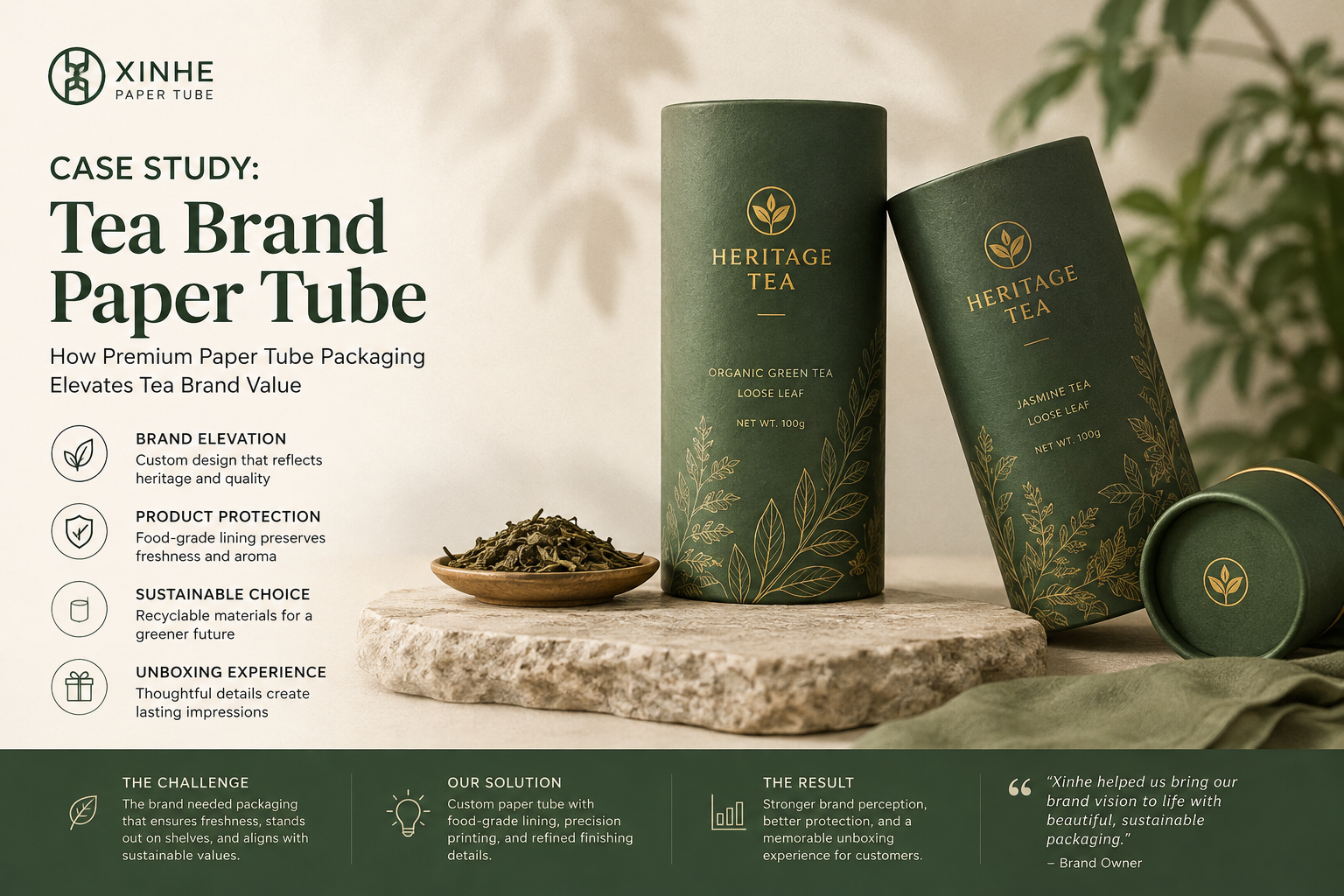
Premium tea, seen before it is tasted
Shelf presence, protection and cost moved together.
Premium tea brands live and die by first impressions. Before a customer ever tastes a single leaf, they judge the product by what’s holding it — and increasingly, that means moving away from tin canisters and plastic pouches toward sustainable, elegant paper tube packaging.
In this case study, we break down how we helped an international specialty tea brand redesign its packaging line using custom spiral-wound paper tubes, and the measurable results that followed.
01 · The challenge
Premium positioning met sustainability pressure.
Our client, a mid-sized specialty tea company selling loose-leaf black, green, and herbal blends across North America and Western Europe, came to us with three core problems:
Outdated packaging
Their existing tin canisters were expensive to source, slow to restock, and didn’t reflect the brand’s evolving “modern botanical” identity.
Sustainability demands
Retail buyers and end consumers were increasingly asking about recyclability and FSC-certified sourcing — something tin and multi-layer plastic pouches couldn’t credibly deliver.
Freight and inventory costs
Metal canisters are heavy and bulky to ship, inflating landed costs and slowing container turnaround.
The brief was clear: design a packaging solution that felt premium, protected the tea’s aroma and moisture sensitivity, and supported the brand’s sustainability claims without raising per-unit costs.
02 · The solution
Spiral-wound tubes with a custom barrier lining.
We proposed a switch to spiral-wound paperboard tubes, engineered specifically for loose-leaf tea’s storage requirements. The final packaging specification included:
FSC-certified kraft
FSC-certified kraft paperboard as the outer structural layer, giving the brand a verifiable, marketable sustainability credential for retail partners in the EU and North America.
Food-grade foil barrier
A food-grade aluminum-foil barrier lining laminated to the inner wall, protecting the tea leaves from moisture, light, and oxygen — critical for preserving flavor and shelf life during long-haul export shipping.
Press-fit lid and inner seal
A press-fit metal or paperboard lid with a tamper-evident inner seal, ensuring freshness is maintained after opening and closing multiple times.
Matte with spot UV
Matte lamination with spot UV detailing on the exterior graphics, giving the tubes a tactile, boutique feel that matched the brand’s positioning against big-box tea brands.
Modular sizing
Modular sizing across 50g, 100g, and 250g formats, all produced on the same tube-winding line to simplify tooling and minimize changeover costs.
We also recommended a kraft-brown base finish with foil-stamped brand marks rather than full-coverage printing — a choice that reduced ink coverage costs while reinforcing the “natural, unprocessed” story central to the brand’s marketing.
03 · Prototyping and sampling
Aroma retention decided the structure.
Because aroma retention was non-negotiable, we ran accelerated shelf-life testing on three lining configurations before finalizing the spec:
- A standard kraft-only tube (control)
- A single-layer foil-lined tube
- A double-layer foil-and-PE composite lining
The double-layer composite outperformed the alternatives in humidity resistance testing, while still remaining within the client’s target unit cost. We shipped physical samples of all three within 10 business days of the initial consultation, allowing the client’s product team to run their own internal sensory panels before committing to a production order.
04 · The results
What changed after the switch.
Within the first two production cycles, the brand reported:
18% lower unit cost
An 18% reduction in per-unit packaging cost, driven by lighter freight weight and simplified single-material recyclability (versus multi-component tin-and-plastic assemblies).
Improved sell-through
Improved retail sell-through, with buyers citing the tactile kraft finish and visible sustainability messaging as a differentiator on crowded specialty-tea shelves.
Faster fulfillment
Faster fulfillment cycles, since paper tubes could be flat-packed and assembled closer to the point of fulfillment, reducing warehouse footprint compared to bulky pre-formed tins.
Simplified compliance
Simplified compliance documentation for EU retail partners, thanks to the FSC chain-of-custody certification carried through from raw material to finished tube.
05 · Why paper tubes work for tea
Barrier performance with an artisanal presence.
Tea occupies a unique niche in packaging: it demands strong barrier protection like coffee, but often competes on a more delicate, artisanal shelf presentation than bulk commodity goods. Spiral-wound paper tubes solve both problems simultaneously — they accept a wide range of barrier linings while offering nearly unlimited surface-finish options, from foil stamping to embossing to soft-touch coatings, that plastic pouches simply can’t replicate.
For brands positioning around wellness, sustainability, or heritage craftsmanship, the packaging itself becomes part of the product story — something a generic pouch rarely achieves.
Protect aroma
Specify the lining around humidity, oxygen, light and target shelf-life requirements.
Express craft
Use the cylindrical canvas, natural kraft and refined finishes to build a distinctive shelf presence.
Get a custom quote
Specify the right structure, lining and finish.
Whether you’re launching a new tea line or migrating away from tins or foil pouches, our team can help you specify the right paperboard structure, barrier lining, and finish for your product’s shelf-life and branding requirements. We offer free sample kits and typically turn around custom prototypes within 7–10 business days.
Request a quote today and tell us your target unit size, order volume, and any existing certifications you need to match — our engineering team will respond with a tailored packaging proposal within 24 hours.