
Choose the right paper tube for your product—not just the right look. Understand materials, sizing, protection and production before you place a custom order.
What is a paper tube?
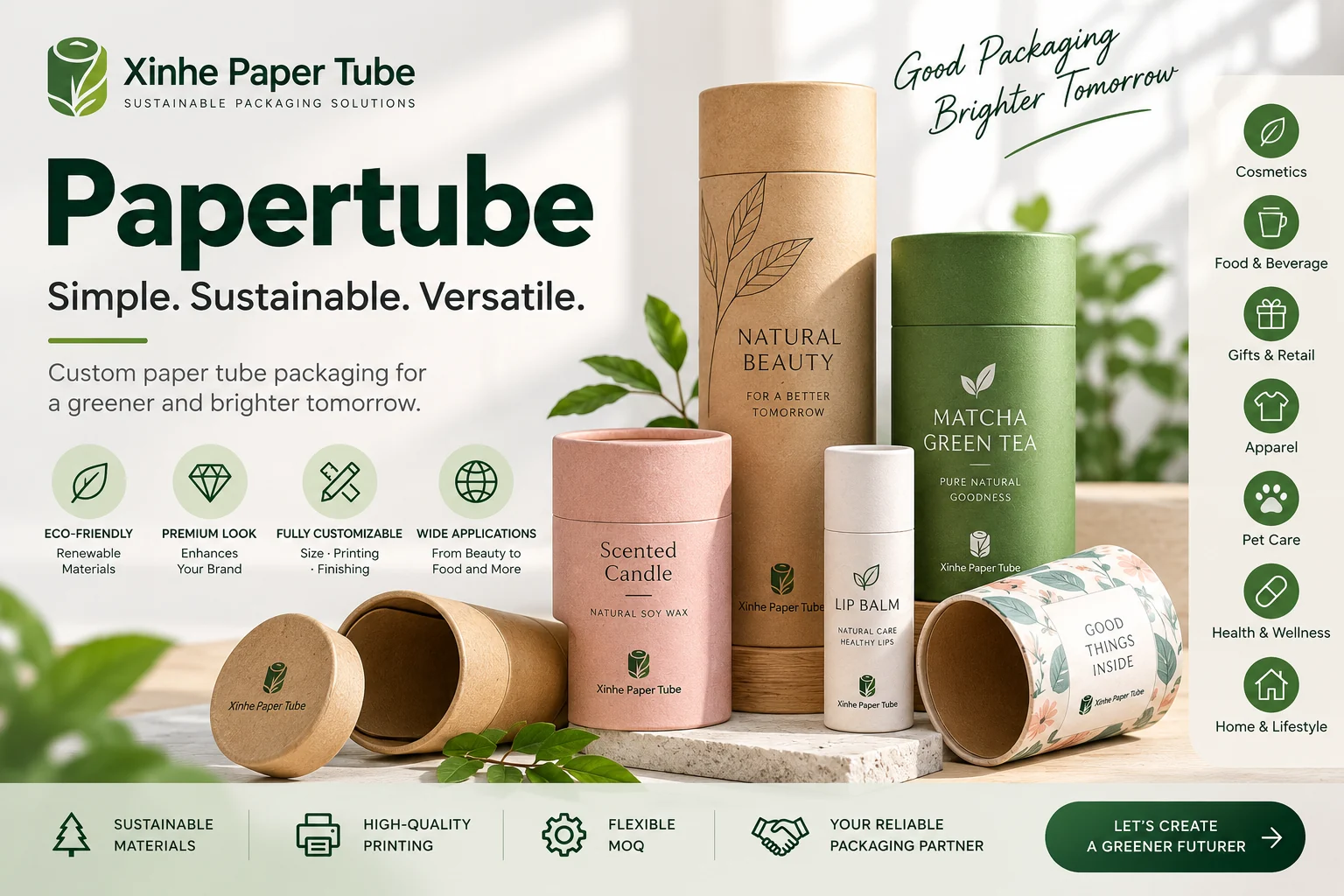
A paper tube is a cylindrical container made by bonding layers of paperboard around a mandrel. Also called a cardboard tube, paper canister or round paper box, it combines a rigid body with a printed outer wrap and a lid or closure.
Xinhe develops custom paper tube packaging for food, beauty, candles, gifts and retail products. This guide helps you turn a product brief into a practical specification.
Protect the product
Match the wall, liner, closure and insert to the product and shipping environment.
Build shelf presence
A continuous printed wrap and tactile paper finishes support distinctive branding.
Plan the full lifecycle
Assess every component, not only the paper exterior, when choosing materials and disposal claims.
Paper tube, carton or rigid box?
Start with product fit and distribution needs. No packaging format is automatically the strongest, cheapest or most sustainable in every application.
| Format | Where it works well | Design advantage | What to check |
|---|---|---|---|
| Paper tube | Round products, tea, candles and gifts | Rigid cylindrical form; continuous wrap artwork | Liner, closure, fit and shipping-carton efficiency |
| Folding carton | Lightweight retail products and flat packs | Can ship flat before assembly; flexible panel layouts | Board grade and support for heavy or fragile contents |
| Rigid box | Luxury sets and multi-item presentations | Structured unboxing and room for shaped inserts | Assembly cost, weight and storage volume |
| Plastic tube / container | Applications requiring a specific barrier or dispensing system | Material and closure options for functional dispensing | Formula compatibility, resin choice and local recovery routes |
For a closer format comparison, read our paper tube vs cardboard box guide. Validate strength and barrier performance on the actual finished pack.
Paper tube structure & materials
The outer paper sets the look. The complete construction determines how the package performs.
- Outer wrapPrinted coated paper, natural kraft or textured specialty paper carries the brand.
- Structural wallBonded paperboard layers provide rigidity. Thickness, winding and adhesive all influence performance.
- Inner linerPaper, grease-resistant layers, foil laminates or a separate inner pack are selected for the contents.
- Lid and baseTelescopic lids, shoulder necks, rolled edges and other paper tube lids and closures shape the opening experience.
- Optional insertA fitted tray or support holds jars, bottles and multiple items in place.
Kraft or a printed finish?
Kraft paper tube packaging creates a natural texture. White coated paper supports detailed artwork, while specialty wraps add texture. Evaluate the finished sample, including seams and color.
Food, moisture and oil contact
Review paper tube liners and barrier options against the actual product. Dry tea, oily snacks and direct-fill balms have different needs; a standard paper lid is not automatically an airtight seal. For food applications, review our food-grade paper tube materials guide.
Responsible claims, by design
Paper-based does not automatically mean plastic-free, compostable or locally recyclable. Check coatings, adhesives, liners and closures, then confirm the disposal guidance for the sales market.
The right size starts with your product.
Measure the product at its widest and tallest points, including pumps, caps and protective wrapping. Use the paper tube size guide to distinguish usable inner dimensions from finished outer dimensions.
Small formats suit balms and samples; mid-sized tubes often hold jars, tea or candles; larger formats can hold bottles and gift sets. Final dimensions and tolerances must be confirmed with the manufacturer.
Example only: a 60 mm-wide jar needs an inner diameter greater than 60 mm, with clearance determined by the insert, tolerances and removal test—not a universal allowance.
- Inner diameter
- Product width plus the agreed clearance and insert.
- Usable height
- Space inside the closed pack, after base and lid intrusion.
- Wall & strength
- Selected for product weight, handling and transit testing.
- Liner & closure
- Chosen for contact conditions, barrier needs and opening feel.
- Print & finish
- Artwork, seam position, color reference and surface treatment.
Not sure which structure fits? Send your product dimensions, weight and intended use for a project review.
Discuss your tube size →Different products. Different priorities.
These are application considerations, not claims about a particular customer’s results or a guaranteed shelf life.
Tea & matcha
Tea paper tube packaging balances gift-ready presentation with a suitable liner or sealed inner bag. Validate aroma, moisture and light protection.
Coffee & dry foods
Coffee paper tube packaging may use an inner bag and an appropriate degassing arrangement. Review food-grade paper tube packaging requirements for the intended product.
Lip balm & beauty
Custom lip balm paper tube packaging needs formula-compatible barriers and a tested dispensing mechanism. Check oil migration and filling conditions.
Candles & fragrance
Paper tube packaging for candles needs a fitted jar support and suitable transit protection. For bottles, explore perfume and fragrance paper tube packaging.
Gifts & retail sets
Gift paper tube packaging can combine inserts, coordinated wraps and a considered lid reveal. Start with the complete contents, not only the outside diameter.
Apparel & accessories
Apparel paper tube packaging works for rolled or folded soft goods. Check presentation, loading time and how easily the customer can remove the product.
How custom paper tubes are made
Six project stages keep structure, artwork and production aligned. The checkpoints below show what to confirm before moving forward.
Review the product
Confirm product dimensions, weight, filling method, destination market and storage conditions. A fragile jar, oily balm and loose-leaf tea need different packaging decisions.
Buyer checkpoint: Product sample or drawing · weight · filling method · transport route
Engineer the structure
Choose the winding method, usable diameter and height, wall construction, closure, liner and insert. Allow room for tolerances and easy product removal; outer dimensions are not usable internal space.
Buyer checkpoint: Inner dimensions · clearance · lid fit · barrier needs
Prepare materials and artwork
Select the outer paper and product-contact materials, then build artwork on the approved dieline. Review the wrap seam, text safe zones, barcode placement and separate files for foil or embossing.
Buyer checkpoint: Material specification · dieline · color reference · finish positions
Approve a physical sample
Check the actual product in the tube, the opening experience and the print finish. For direct-fill products, test the chosen liner with the formula and filling conditions. Record the approved sample and any changes.
Buyer checkpoint: Product fit · opening force · filled-pack compatibility · signed approval
Produce and monitor
Production may include winding, curing, cutting, printing, wrapping, edge forming and assembly; the sequence varies by construction. In-process checks help identify size drift, glue marks and color variation before final packing.
Buyer checkpoint: Approved specification · in-process checks · change control
Inspect and pack for shipment
Check dimensions, print appearance, lid fit, seams and the agreed sampling plan. Confirm outer cartons and protective inserts against the distribution conditions, then retain reference samples for repeat orders.
Buyer checkpoint: Inspection criteria · carton protection · labels · retained samples
Use paper tube printing and finishing options to compare CMYK, spot colors, foil, embossing and surface treatments before sample approval.
Look beyond the quotation.
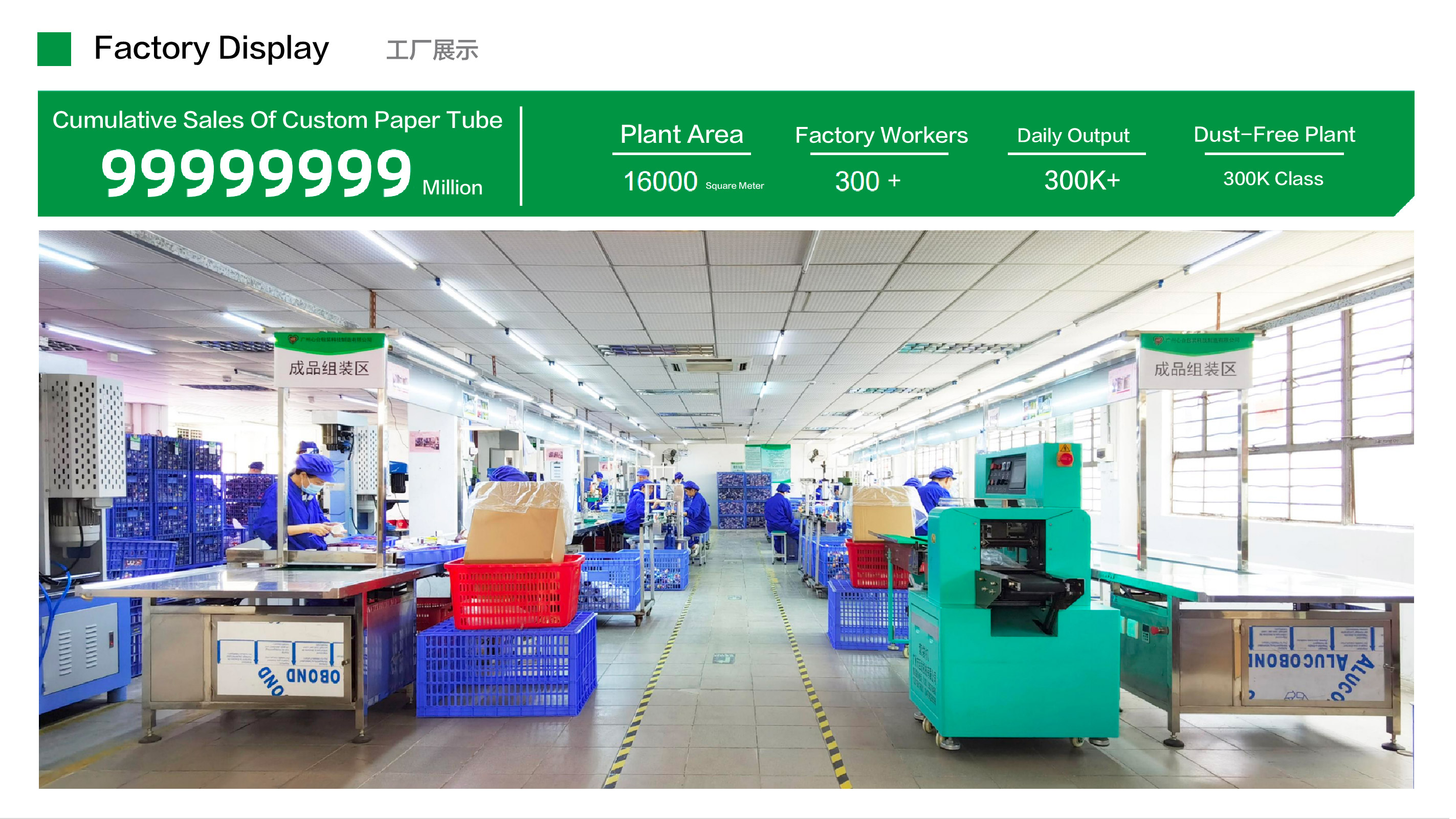
A paper tube manufacturer should help translate your product requirements into a repeatable specification. Ask how the team controls dimensions, material changes, color, lid fit and export packing.
Review the Xinhe paper tube factory tour and certification and compliance references. Verify the scope and validity of documents relevant to your order rather than treating a certificate logo as approval for every product.
Before choosing a supplier, review how to audit your paper tube manufacturer. Explore existing paper tube packaging project examples for design context, and request a sample with comparable materials and structure.
MOQ, cost and timing: compare the same construction, quantity per design, finish and packing terms. Our MOQ, cost and lead-time guide explains the main variables. Request project-specific figures in writing.
Paper tube packaging FAQ
Quick answers to the questions that matter before sampling and ordering.
Are paper tubes recyclable?
Many paper-dominant tubes can be recycled, but acceptance depends on local collection systems, product residue, coatings, liners and closures. Confirm the complete structure before making a recyclable or plastic-free claim; paper content alone does not prove compostability.
Are paper tubes food safe?
They can be designed for food packaging when the product-contact materials and complete pack are suitable for the intended food, contact time, temperature and target market. Request the relevant material documentation and validate the filled pack; a paper exterior is not proof of food safety.
Can I order a custom paper tube size?
Yes. Specify usable inner diameter, usable inner height, product weight, liner, insert and closure. The engineering review confirms tooling, clearance and tolerances before a sample is approved.
What is the typical MOQ for custom paper tubes?
MOQ depends on diameter, construction, print method, special components and the number of designs. Ask for a written MOQ and quantity-price options for your exact specification rather than assuming one minimum applies to every tube.
How long do samples and bulk production take?
Timing depends on tooling, artwork approval, material availability, finishing and order quantity. Confirm separate dates for sampling, approval, production and shipping. Bulk production should follow approval of the final specification and sample.
What is the difference between spiral-wound and convolute-wound tubes?
Spiral winding wraps paper strips at an angle around a mandrel, producing a diagonal seam. Convolute winding wraps sheets with their edges parallel to the tube axis. Select construction according to dimensions, strength and production requirements, rather than assuming one method is always superior.
Can paper tubes have windows, handles or inserts?
These features can be considered during structure development. Openings may reduce strength or barrier performance; handles need a load check. Inserts should prevent movement without making removal difficult. Confirm the complete structure on a sample.
Which certifications should I request?
Ask for current certificates and supporting documents relevant to your project. Check the legal entity, site, scope and validity. FSC concerns responsible sourcing and chain of custody; management-system certification does not replace product-specific food-contact or performance evidence.
Do you provide a dieline for artwork?
Request a dieline after the tube structure is agreed. Confirm wrap dimensions, overlap seam, bleed, safe areas and the placement of barcodes and special finishes. Approve the physical result before repeat production.
What information is needed for a quote?
Send product dimensions and weight, quantity per design, intended use, target market, material and finish preferences, closure and liner needs, artwork or references, delivery country and launch date. Include any food-contact or other compliance requirements.
Bring your product. Let’s plan the packaging.
Send product dimensions, weight, quantity per design, artwork or references, destination and launch date. Include liner, closure and compliance needs so we can review a suitable structure and quotation.
Request your custom paper tube quote →Dimensions, MOQ, price and schedule are confirmed for each project.