
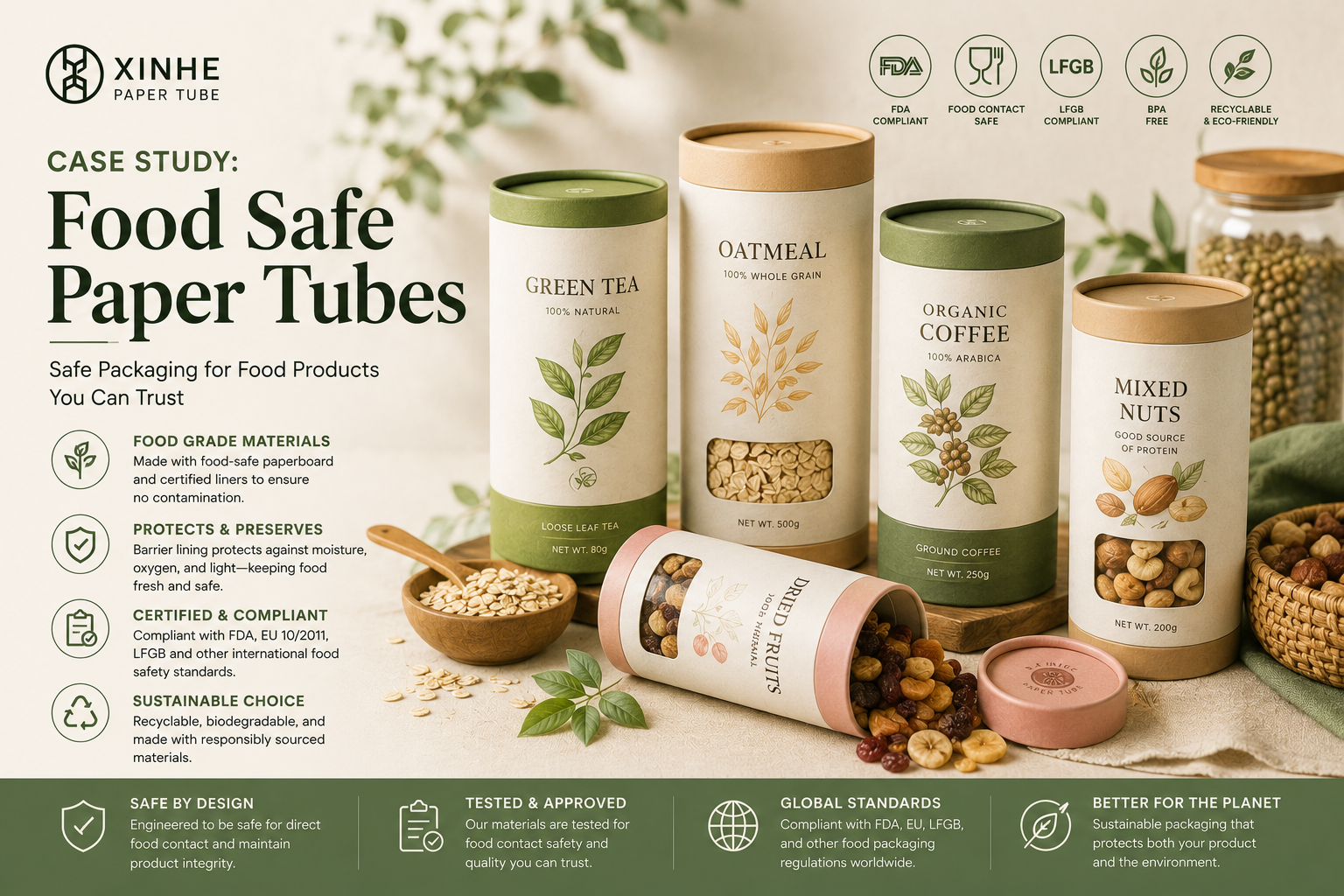
Food-contact packaging guide
Food-safe is a complete system—not a paper label.
The short answer is yes: food-safe paper tubes can be used for many dry food, powder, snack, tea, coffee, spice, candy, chocolate, and supplement products when they are manufactured with the right paperboard, liner, inks, adhesives, and controlled production processes.
However, not every paper tube is suitable for food contact. A regular gift tube and a food-grade paper tube may look similar from the outside, but the internal materials, barrier layer, hygiene controls, and test reports can be very different.
01 · Define the contact model
Direct contact and secondary packaging are not the same brief.
The packaging structure should be specified around how the food is filled, stored, opened, resealed, shipped, and sold—not from appearance alone.
The food touches the tube or liner
The inner surface, liner, inks, adhesives, hygiene controls, migration risk, and supporting documentation all become critical. Test samples with the real food product before confirming mass production.
The food is sealed in an inner pouch
The paper tube mainly provides structure, protection, branding, and shelf presentation. A simpler tube structure may be possible, depending on the product, pouch, target market, and storage conditions.
02 · Common applications
Dry foods with very different protection needs.
Product composition, aroma, oil content, particle size, filling method, and target shelf life determine the final specification.
Coffee
Whole bean, ground, and instant coffee often need aroma, oxygen, moisture, and light protection.
Tea
Loose leaf, matcha, herbal tea, and tea bags require careful aroma and humidity management.
Spices
Salts, seasonings, and dry ingredients may need aroma control, oil resistance, and clean dispensing.
Snacks
Chocolate, candy, biscuits, cookies, nuts, and dried fruit require product-specific grease and moisture control.
Powders
Protein powder, collagen powder, and drink mixes need fine-particle containment and moisture protection.
Supplements
Vitamins and nutritional products may require labeling space, tamper evidence, and market-specific documentation.
03 · What makes a paper tube food safe?
Five parts of one packaging system.
The exact structure changes with the product and market, but these are the main elements buyers should confirm.
Paperboard
Food-grade virgin paperboard or another approved paper material, specified for the intended packaging use.
Inner liner
A food-safe barrier such as aluminum foil, PET, PLA, or an oil-resistant coating, selected around the product’s risk profile.
Inks and adhesives
Low-migration inks and suitable adhesives, managed so the printed and bonded construction supports the intended contact use.
Barrier performance
Moisture, grease, oxygen, light, or aroma protection where required to help preserve freshness and product integrity.
Production controls
Clean manufacturing, controlled materials, dimensional inspection, closure checks, traceability, and final quality review.
04 · Materials and liners
Select the barrier around the food—not the trend.
Confirm moisture, oil, aroma, light, shelf-life, storage, and resealing requirements before choosing a liner.
Aluminum foil
Often considered for coffee, tea, powders, and moisture-sensitive products that need strong barrier performance.
PET
Used when a smooth food-contact barrier is required, subject to the product, structure, and destination-market rules.
PLA or bio-based options
Considered when brands prioritize lower-impact materials, while still validating performance and local disposal claims.
Oil-resistant coating
Used for products that may release grease or oils, with compatibility verified against the real product.
Important: A material name alone does not prove suitability. The full construction, supplier declaration, test conditions, food type, contact time, temperature, and destination market should be reviewed together.
05 · Certifications and test reports
Evidence should match the product, market, and contact use.
Evidence relating to food-packaging hygiene management and controlled production.
Quality-management documentation that supports consistent production and corrective control.
Responsible paper sourcing documentation for eligible paper materials and chain-of-custody claims.
Third-party or supplier evidence requested when relevant to the material, food type, use condition, and destination market.
The certification and test requirements vary by project. Logos or references on this page describe common buyer requirements and should not be read as a blanket compliance claim for every paper tube structure.
06 · Prepare the packaging brief
Five checks before a production order.
State whether food touches the liner directly or is sealed in a pouch.
List moisture, grease, oxygen, light, aroma, and resealing requirements.
Share filling weight, product dimensions, tube size, and transport method.
Confirm the material declarations, certifications, and reports needed for the target market.
Validate fit, filling, barrier, closure, storage, and transit with the actual food product.
Develop a food-safe paper tube
Start with the product and contact requirements.
Share the food type, filling weight, tube size, shelf-life target, storage conditions, inner-pouch details, destination market, and artwork. Xinhe can recommend a practical paperboard, liner, closure, and sample plan for your project.