
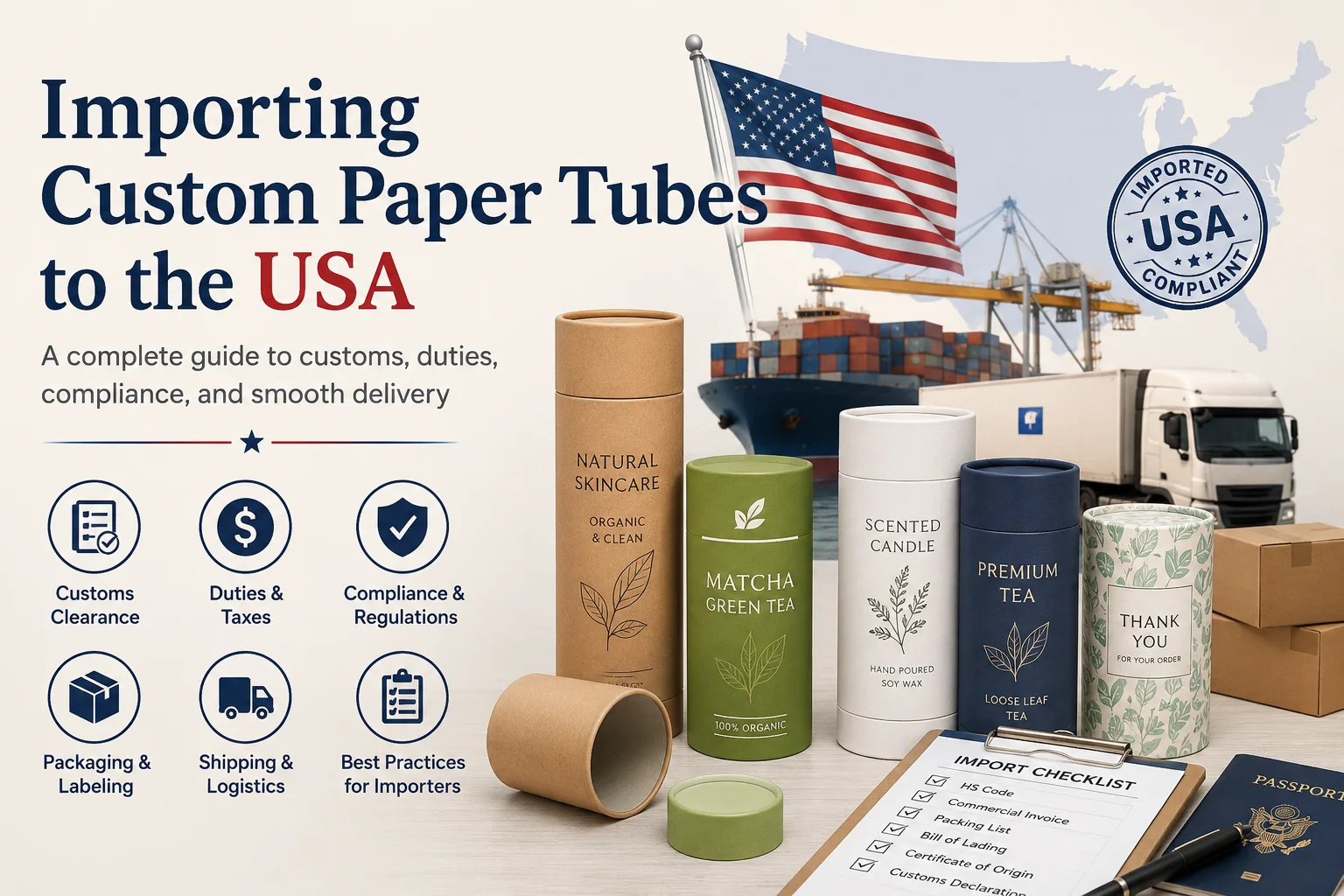
Importing custom paper tubes to the USA requires more than agreeing on price and freight. The importer must confirm tariff classification, country of origin, customs value, documentation, any additional duties and product-specific requirements before the goods arrive.
This practical guide explains the decisions U.S. buyers should make when sourcing custom paper tubes from overseas. It is designed for procurement teams, packaging brands and first-time importers—not as legal or customs advice.
Why U.S. Brands Source Paper Tubes
Rigid paper cylinders can package cosmetics, candles, tea, coffee, gifts, apparel and promotional products. Their value comes from structural protection, a strong printable surface and a premium unboxing experience—not from unsupported market-size claims.
Premium Packaging Format
Modern paper tube packaging combines a rigid wound-paper body with custom wraps, fitted lids and optional inserts. Diameter, height, wall thickness and closure should be engineered around the product and shipping environment.
Material-Led Brand Story
Eco-friendly paper tube packaging can reduce reliance on rigid plastic and create a natural shelf presence. Environmental statements still need to reflect the complete structure, coatings and local recovery system.
Kraft and Printed Finishes
Natural kraft paper tubes support an earthy aesthetic, while white or specialty wraps can carry detailed CMYK, Pantone, foil, embossing and matte finishes for premium retail programs.
Recycled Content With Evidence
When specifying recycled paper tubes, request documentation for the actual paper grade and recycled-content percentage. Recycled content and recyclability are different claims and should be substantiated separately.
Do Not Assign One Code to Every Paper Tube
U.S. classification follows the imported article’s objective characteristics and intended use. A shipping core, retail container, composite tube and filled package may not share the same provision.
The current 2026 HTS displays 4822.90.00 for “other” bobbins, spools, cops and similar supports of paper pulp, paper or paperboard. That heading describes supports used for winding—not every cylindrical retail package. Confirm whether the imported tube is a support, a paperboard container or another article before entry.
Document the Article
Record material layers, dimensions, closure, inserts, lining, printing, intended contents and whether the tube is imported empty or filled. Generic descriptions such as “paper packaging” are insufficient for a defensible classification.
Check the Current HTS
Use the official USITC schedule to compare candidate headings and Chapter 48 notes. Search the current schedule rather than reusing a supplier’s old code.
Check the official 2026 HTS →Use Reasonable Care
A licensed broker can recommend a classification, but the Importer of Record remains responsible. For material uncertainty or recurring volume, consider a prospective CBP binding ruling before shipment.
CBP eRuling portal →Calculate the Full 2026 Import Cost
Duty is not a single percentage copied from a quote. The final amount depends on classification, customs value, origin, active trade measures, available exclusions, entry type and applicable user fees.
Base HTS Duty
Confirm the general duty rate in the current HTS for the final classification. Do not assume all paper products are free or use a broad 0–5% estimate.
Section 301 Tariffs
For China-origin goods, additional duties apply only when the HTS classification is covered by the relevant USTR action or Chapter 99 provision. There is no universal 7.5–100% rate for all paper tubes; check the current lists and any valid exclusion.
USMCA / Free Trade Agreements
USMCA preferential treatment is limited to qualifying originating goods of the United States, Mexico or Canada. Shipping China-origin tubes through Mexico or Canada does not by itself confer USMCA origin.
MPF and Other Fees
For FY2026, CBP states that formal entries generally use a 0.3464% Merchandise Processing Fee, subject to a $33.58 minimum and $651.50 maximum, unless an exemption applies. Ocean cargo can also involve harbor, port, terminal and security-filing costs.
Verify the current CBP MPF →Five Steps Before the Shipment Leaves
The cleanest customs entries are prepared during product development, when the importer can still correct descriptions, markings, documents and landed-cost assumptions.
Confirm the owner or purchaser responsible for entry, or establish the structure for a foreign importer with qualified U.S. representation.
Use a licensed customs broker familiar with paper packaging, China-origin entries and the relevant port.
Provide samples, drawings, materials and end use. Resolve the tariff number and Chapter 99 treatment before commercial invoicing.
Confirm how country of origin will be shown on the article or its qualifying outermost container and avoid misleading “Made in USA” presentation.
Align Incoterms, bond, ocean or air documents, arrival timing and any required security filings with the broker and freight forwarder.
Build a Customs-Ready Document Set
Names, quantities, values, descriptions, origin, weights and package counts should agree across the invoice, packing list and transport documents.
Describe the Goods Precisely
Include buyer and seller, detailed merchandise description, quantity, unit and total value, currency, country of origin, Incoterm and the confirmed tariff classification. CBP requires invoice information before release.
CBP invoice requirements →Match Every Carton
List carton count, net and gross weight, dimensions, SKU quantities, pallet configuration and package marks so Customs and the warehouse can reconcile the cargo.
Bill of Lading or Air Waybill
Confirm shipper, consignee, notify party, ports, container number, marks and description. Ocean shipments may need Importer Security Filing data before loading.
Keep Specifications and Certificates
Retain drawings, material composition, purchase orders, payment records, origin support, test reports and any product-contact or agency documentation relevant to the intended use.
Estimated Import Cost Calculator
Use this calculator for early budgeting. Enter the rates confirmed for your HTS classification and country of origin. It includes the FY2026 formal-entry MPF limits but does not replace a broker’s entry calculation.
MPF is estimated at 0.3464%, with the FY2026 formal-entry minimum and maximum. It does not account for exemptions, Harbor Maintenance Fee, antidumping/countervailing duties, product-specific agency fees or valuation adjustments.
Planning estimate
Choose a Supplier That Supports the Entry
The exporter does not replace the Importer of Record or broker, but accurate supplier records can prevent classification, valuation and clearance problems.
Clear Product Specifications
Request confirmed dimensions, material layers, wall thickness, closures, inserts, coatings, product-contact surfaces and intended-use information for every SKU.
Evidence for Materials
For sustainable packaging, obtain current certificates and scope statements for the exact paper and structure. Avoid broad claims that cannot be traced to the supplied SKU.
Consistent Shipping Documents
The commercial invoice, packing list, carton marks and transport instructions should use the same product description, quantities, values and origin information approved by the importer.
Approve Before Production
Review structure, fit, print, finish, barcode, warning copy and country-of-origin presentation on a physical sample before mass production.
Test the Distribution Pack
For e-commerce packaging, test the retail tube together with its insert and corrugated shipper. A premium tube may still need secondary protection for parcel networks.
Keep an Audit Trail
Archive quotations, purchase orders, approvals, material declarations, payment records, photos and final shipping documents according to the importer’s recordkeeping process.
Pre-Shipment Review
Send this checklist to the procurement, supplier, broker and freight teams before cargo is booked.
U.S. Paper Tube Import Questions
Concise answers to the classification, tariff and compliance questions that most often delay first shipments.
Is 4822.90.10 the correct HTS code for every paper tube?
No. The 2026 U.S. HTS shows 4822.90.00 for certain other bobbins, spools, cops and similar paper supports, but retail packaging tubes may be classified elsewhere depending on construction and use. Confirm the full 10-digit classification with a licensed customs broker or request a CBP binding ruling.
Are custom paper tubes duty-free when imported into the USA?
Not automatically. The base duty depends on the final HTS classification, and additional Chapter 99 or Section 301 duties may apply based on country of origin and the current tariff lists. Fees such as MPF and ocean-related charges may also apply.
Does USMCA apply to paper tubes made in China?
Generally no. USMCA preferential treatment is for qualifying originating goods of the United States, Mexico or Canada. Routing Chinese-origin goods through Mexico or Canada does not by itself make them USMCA-originating.
Who can be the Importer of Record?
The owner or purchaser of the goods may act as the Importer of Record, and a properly designated licensed customs broker may make entry in qualifying circumstances. The IOR remains responsible for reasonable care, classification, valuation and compliance.
What documents are normally needed?
A typical commercial shipment uses a detailed commercial invoice, packing list, bill of lading or air waybill, entry data, country-of-origin information and any product-specific documents. Ocean shipments may also require timely security filings. Requirements vary by shipment and product use.
Do food or cosmetic paper tubes need extra compliance review?
Possibly. Empty packaging can trigger requirements that depend on materials, intended use, product contact and the filled product. Coordinate with the relevant U.S. agency specialists, your customs broker and product compliance adviser before shipping.
Compliance note: Tariff schedules, trade remedies, fees and agency requirements can change. This page was updated on September 3, 2026 for general planning and is not legal, tax or customs advice. Confirm the current HTS, Chapter 99 provisions and entry requirements with CBP and a licensed customs professional before importing.
Get a Quote Built for U.S. Import Planning
Share your tube dimensions, materials, closures, quantity, artwork, intended contents, U.S. destination and shipping plan. Xinhe can prepare a clear packaging quotation and the product specifications your broker needs for review.
Get a free quote for custom paper tubes →