
Choose the food-contact layer first. Then validate the barrier, closure and complete pack for your food and destination market.
Better decisions start inside the tube.
Food grade paper tube packaging materials include the outer wrap, structural paperboard, liner, adhesives and closures. The right combination depends on what touches the food, how it is filled, and the protection needed through storage and distribution.
This guide helps buyers compare material options and prepare a testable brief for custom food grade paper tube packaging. It is technical planning guidance, not a certificate for a particular construction.
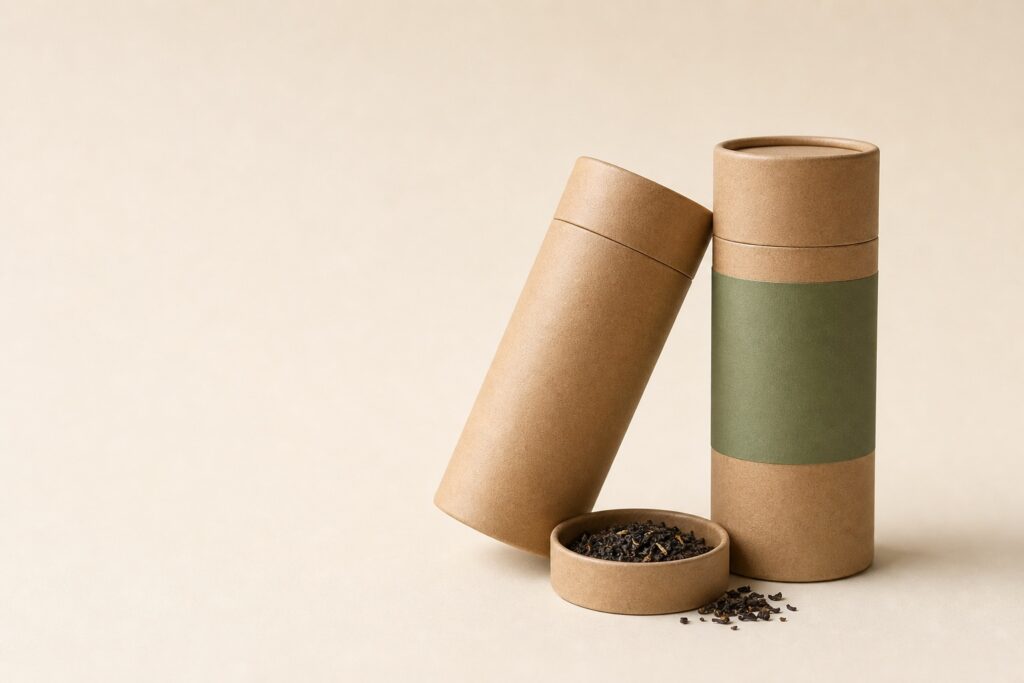
What makes a paper tube “food grade”?
The term describes suitability for an intended use—not one universal paper grade, logo or certificate. Review the complete construction against the food type, contact time, temperature and target market.
Direct contact or a separate inner pack?
With direct filling, evaluate the exposed liner, side seam, base, top seal and closure. If food is inside a sealed bag or individually wrapped, the tube mainly provides structure and presentation. The inner pack must still be suitable, remain intact and prevent relevant transfer from other packaging components.
United States
Ask for the regulatory basis for each relevant component and its intended conditions of use. Paper and paperboard provisions include 21 CFR 176.170 for aqueous and fatty foods and 176.180 for dry food, where applicable; adhesives, coatings and polymers can involve other provisions. An FDA logo is not a substitute for this review.
European Union
Review the framework Regulation (EC) 1935/2004 and GMP Regulation (EC) 2023/2006, together with material-specific and relevant national rules. Regulation (EU) 10/2011 concerns plastics; it does not provide a blanket approval for a whole paper tube. Confirm the latest applicable requirements with a qualified compliance specialist.
Source: European Commission food-contact legislation.
Read evidence, not just certificate names.
FSC concerns responsible sourcing and chain of custody. ISO 22000 and BRCGS address defined management or site systems. An SGS or other laboratory report concerns the sample and tests described. None should be presented as proof that every supplied tube suits every food. Check current certification and compliance references for the exact site, scope and construction.
Three layers. Different responsibilities.
Outer wrap
Kraft, white or specialty paper changes the look, feel and print result. Review rub resistance, odour and ink or coating transfer during manufacture and storage. Kraft paper food packaging tubes still need a suitable internal construction; a natural-looking surface is not food-contact evidence.
Structural paperboard
Specify paper grade, ply arrangement, finished wall thickness and tolerances separately. GSM measures mass per area; millimetres measure thickness. Neither alone proves crush performance. Use the paper tube wall thickness guide to plan the complete pack rather than applying one generic minimum.
Inner liner and bonding system
The contact layer may be treated paper, a coated structure, a laminate or a separate pouch. Verify material identity, exposed edges, bonding and change control. A coating described as “water-based” or “plant-based” is not automatically safe for direct food contact.
Which inner liner should you consider?
These are construction options to discuss, not an approved list for every food. Availability, performance and cost must be confirmed for the proposed grade and assembly.
On a phone, swipe the table horizontally to compare all columns.
| Option | Why consider it? | What to verify | Recovery and cost considerations |
|---|---|---|---|
| Aluminium-foil laminate | Potential high barrier to light, oxygen and moisture for sensitive dry foods. | Exact laminate, pinholes or damage, sealability, seams and whole-pack leakage. | Bonded layers complicate separation. Not compostable; quote foil, sealant and conversion together. |
| PE-coated or PE-lined structure | Moisture and grease protection with a suitable sealant grade. | Coating continuity, food-contact basis and oxygen/aroma needs; PE alone may not meet high-barrier targets. | Contains plastic; do not assume paper-stream acceptance. Gauge and tooling affect cost. |
| PLA-based coating or film | A bio-based plastic option where the selected grade suits the process. | Temperature resistance, barrier data, adhesion and filling conditions; performance varies by grade. | Whole-pack compostability needs evidence and a stated disposal route. Confirm sourcing and conversion cost. |
| Grease-resistant paper | Helps control oil staining in an appropriate construction. | Treatment chemistry and oil resistance. Grease resistance does not establish oxygen or moisture protection. | Recyclability and compostability depend on treatment and assembly; confirm grade and order minimum. |
| Separate sealed inner bag | Lets the primary food-contact pack be designed independently of the rigid tube. | Bag compliance, sealing, puncture risk, headspace and fit after filling. | May allow component separation; adds a filling step and material cost. State disposal instructions separately. |
A silver-coloured film is not necessarily aluminium foil. Request the layer specification. Likewise, “bio-based” does not mean plastic-free or home-compostable. Compare paper tube liners and barrier options using test evidence, not star ratings.
Ask for conditions alongside the numbers.
A useful specification makes each requirement measurable. Generic figures without a method, specimen description or test environment can create false confidence.
Wall thickness and strength
Record usable inner diameter, usable height, wall thickness and tolerances in millimetres. State the filled weight, stack arrangement and humidity. Validate compression and transport performance on the tube plus its shipping carton; corrugated-board ECT is not a universal tube-wall acceptance test.
OTR and WVTR / MVTR
Request oxygen transmission and water-vapour transmission data with units, temperature, relative humidity, test method and sample thickness. Film results may use cm³/(m²·day) and g/(m²·day); whole-pack results use a per-package basis. Do not compare them directly or omit pressure conditions where relevant.
Filled-pack and seal checks
Test the final liner, seam, base and closure with the intended filling process. Assess leakage, odour or taste transfer and the food’s actual quality criteria. Real-time shelf-life work may be supported by justified accelerated studies; an attractive empty sample cannot establish a shelf-life claim.
Traceable test evidence
Ask for sample identity, complete construction, report date, test conditions, applicable limits and a link to the material supplied. Changes to adhesive, liner or converter can require reassessment. A raw-film datasheet is useful but is not a finished-package result.
Technical reference: AMETEK MOCON explains transmission-test conditions and film versus whole-package results.
Start with what the food needs.
Tea and coffee
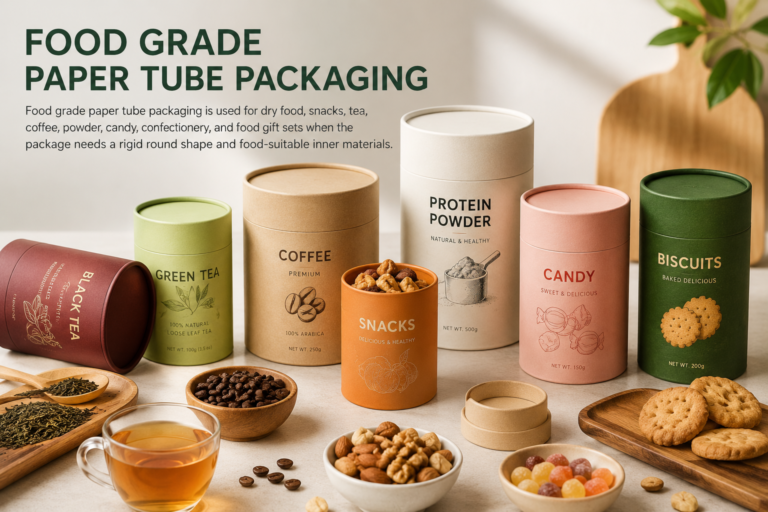
Review moisture, oxygen, light and aroma retention. Freshly roasted coffee can need a degassing strategy. Compare custom paper tubes for tea packaging and coffee paper tube packaging with the planned liner and primary seal.
Powders and seasonings
Prioritize moisture uptake, powder leakage and clean sealing surfaces. A sifter is a dispensing feature, not proof of a storage barrier. See protein powder barrier requirements and spice paper tube packaging for application planning.
Snacks and chocolate
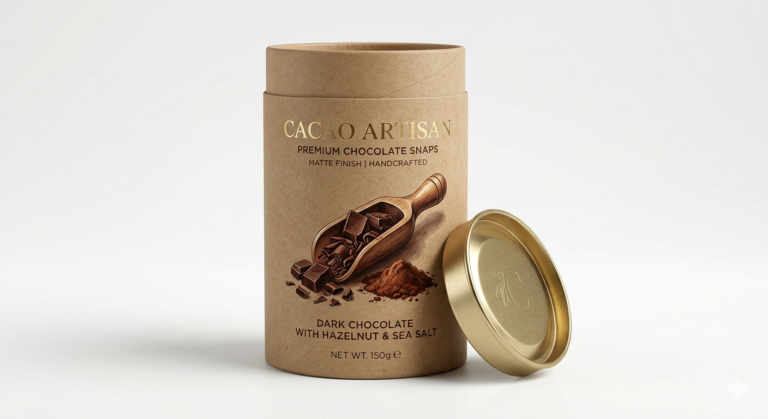
Consider oil migration, oxygen sensitivity, odour and crushing. A grease-resistant contact layer may prevent staining while a separate barrier is still needed. Explore chocolate paper tube packaging with your food and storage conditions.
Gift foods
For individually wrapped items, keep the primary pack’s protection intact and design the tube around fit and transit. Retail appearance matters, but it does not override food safety. These examples concern dry-food planning; wet, hot-filled, chilled or retorted products need a dedicated assessment.
Prepare a liner conversation.
Select your application and contact route to see the issues to discuss with the packaging team. The tool does not calculate shelf life or approve a food-contact material.
For disposal claims, review the full package—not just its paper percentage. Our paper tube recyclability guide explains the practical questions. The FTC Green Guides also require substantiation and appropriate qualification of environmental claims.
Turn the idea into an approved specification.
Define food contact
Record food type, fat or moisture sensitivity and whether the food touches the tube or stays in a sealed inner pack.
Set storage and shelf-life conditions
Specify shelf-life target, filling and storage temperatures, humidity, and unopened and after-opening expectations.
Confirm the structure and evidence
Agree usable dimensions, liner, closures and target markets; review the intended-use compliance basis and test plan.
Validate the filled sample
Check filling, seal integrity, sensory quality, relevant safety criteria, moisture or oxygen performance and the final transport pack.
Approve the controlled specification
Record the approved sample, material identities, tolerances, acceptance criteria and change-control requirements before production.
Use the two-page worksheet to capture requirements, evidence and acceptance criteria.
Download the specification PDFCompare like-for-like quotations.
Food-contact materials, documentation, controlled handling and validation can add cost. Diameter, special laminates, closure sourcing, artwork variants and order size also affect the purchasing minimum and schedule.
Ask the quote to separate six items: material construction, closure and assembly, printing and finish, tooling or setup, samples and testing, and bulk packing and freight. Review paper tube lids and closures alongside the paper tube MOQ and lead-time guide. No single price or turnaround applies to every specification.
Send these seven items for an RFQ
- Food type, fill weight and contact route
- Usable dimensions and filling method
- Shelf-life and storage requirements
- Destination market and compliance needs
- Liner, closure and disposal preferences
- Quantity per design and artwork / finish
- Delivery destination and required date
Food-grade paper tube material FAQ
Can paper tubes be used for direct food contact?
Yes, when the complete food-contact construction is suitable for the food, contact time, temperature and destination market. Verify the liner, seams, bottom, closure and any exposed adhesive. A decorative paper exterior alone does not establish suitability.
Does a foil liner make a paper tube airtight?
Not by itself. The foil laminate, side seam, base, top seal and closure must work together. A friction-fit paper lid is not proof of a hermetic seal. Validate leakage and the filled package under the intended conditions.
What is the shelf life of food in paper tubes?
There is no universal shelf life. It depends on the food, initial quality, oxygen and moisture sensitivity, filling process, barrier system and storage. Establish the claim through product-specific shelf-life testing, including sensory and safety criteria as appropriate.
Is PLA-lined paper tube packaging compostable?
PLA is a plastic, even when bio-based. A resin or film certificate does not establish that a complete tube, including inks, adhesives and closures, is compostable. Verify the finished construction and whether the claim concerns industrial or home composting.
Are food-grade paper tubes recyclable?
Recyclability depends on the full construction, separability, food residue and local collection and processing. A paper body with bonded foil or plastic can need a different recovery route from an uncoated paper tube. Check the destination market before printing a claim.
What certifications or test reports should I request?
Request a material specification and intended-use compliance basis, relevant test reports for the exact construction, lot traceability and any buyer-required site certificates. Check scope, validity and food-contact conditions. FSC sourcing or a laboratory logo alone is not food-contact approval.
What wall thickness should I choose?
Specify usable dimensions, filled weight, stacking, humidity and shipping conditions, then validate the sample and transport pack. Paper grammage and finished wall thickness are different measurements. There is no single minimum thickness that proves every food tube is safe or shipment-ready.
Can recycled paperboard be used?
It may be considered in an appropriate construction, but suitability depends on source control, potential contaminants, barriers and the intended food contact. Do not assume either recycled or virgin paper is automatically compliant for every use.
What is the MOQ for custom food paper tubes?
MOQ depends on diameter, liner sourcing, closure, print method and the number of designs. Request a written MOQ and quantity-price options for one fully defined specification. Special laminates or components may have separate purchasing minimums.
Can I order a sample before production?
Ask for a structure sample and then a production-representative sample with the agreed liner, adhesive, print and closure. Use your actual food and filling process for compatibility and shelf-life validation before authorizing bulk production.
Related technical resources
Move from material selection to the complete buying and validation workflow.
Request a factory-direct quote.
Share your food, contact route, dimensions, shelf-life target, market, quantity and delivery plan. Xinhe can review the construction and sampling requirements before preparing a project-specific quotation.
Material availability, test scope and compliance evidence are confirmed for the agreed specification.